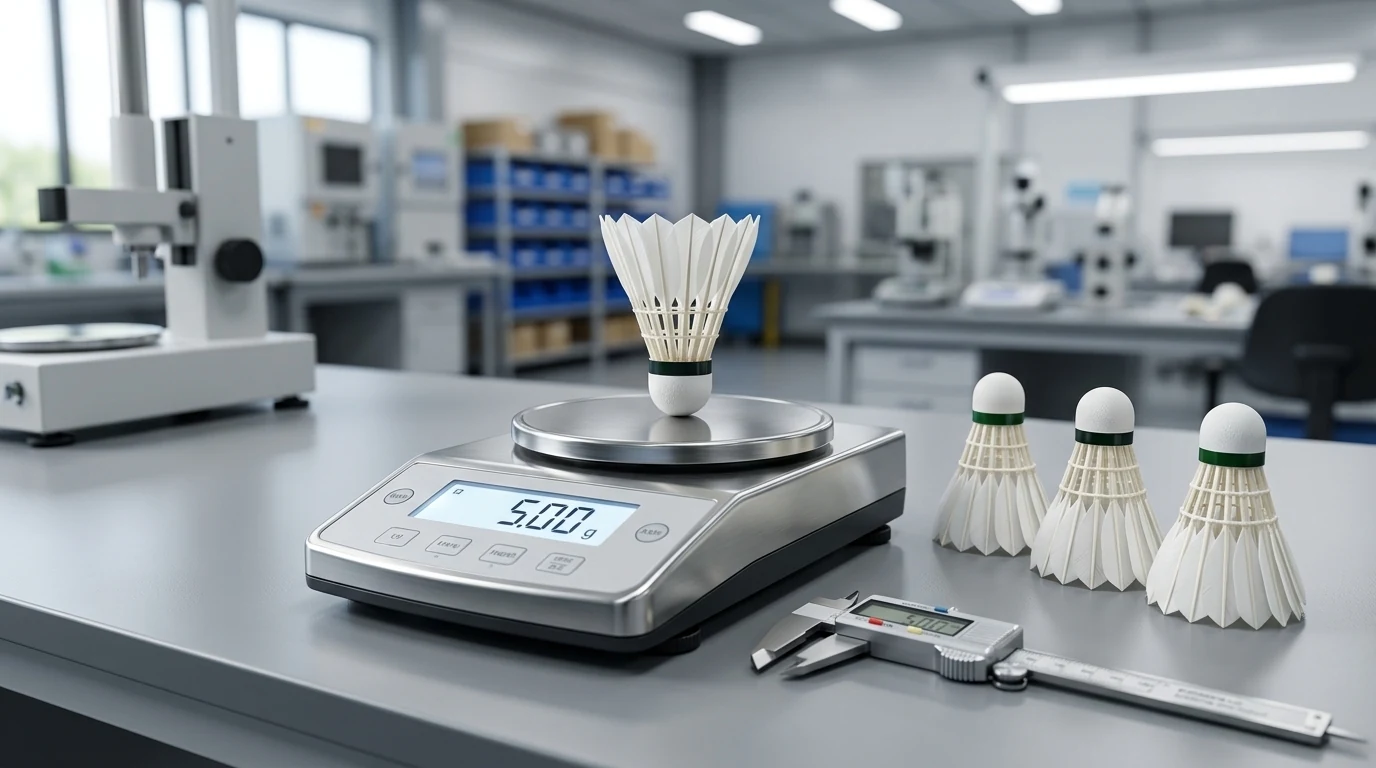
How air density, court temperature (°C / °F), elevation and humidity change feather shuttlecocklanding distance—and how to specify the exact speed code for your market.
Reviewed by Shuttlecock Supplier Technical & QC Desk · Anhui & Zhejiang Supply Chain · Last updated October 31, 2026 · BWF Standard Reference
INTERNATIONAL SPEED CALIBRATION MATRIX
Shuttlecock speed codes 75–79 by temperature, altitude & targetlanding zone
Badminton shuttlecock speed codes 75 to 79 matched to temperature, altitude, grain weight and regional markets
Metric Speed Code
Approximate Weight / Grain Equivalent
Hall Temperature (°C / °F)
Elevation / Air Density
Primary Regional Markets & Season
Speed 75 (Slowest)
~4.74 – 4.85 g (Grain 73–74)
> 28 °C (> 82 °F)
High altitude (> 1,200 m / 4,000 ft) or hot tropical halls
How air temperature and altitude alter shuttlecock flight distance
Warm air and high-altitude air are less dense, offering less aerodynamic drag against the 16-feather skirt. A Speed 77 shuttlecock tested at 18 °C at sea level will fly 30–50 cm further—often sailing past the back doubles service line—when played in a 27 °C tropical hall or at 800 metres elevation. Choosing Speed 76 compensates for thinner air so the shuttle lands squarely inside the BWF test zone.
02 / BWF SPEED TEST PROTOCOL
How to verify shuttlecock speed on your own club courts
Under BWF Law 4.4, a player strikes the shuttlecock with a full underhand stroke from the back boundary line, making contact above the back line and parallel to the sidelines. A correctly matched shuttlecock lands between 530 mm and 990 mm short of the opposite back boundary line (inside the two doubles long-service test marks). Always test 3 shuttles per sample tube after acclimating the tube in your hall for 24 hours.
03 / SEASONAL SPLIT ORDERS
Splitting winter and summer speed codes in one wholesale shipment
Importers and clubs in four-season regions (such as North America, Europe and East Asia) frequently split a 10-carton (500-tube) order into 60% Speed 77 (spring/summer/autumn) and 40% Speed 78 (winter). We label each tube end-cap and master carton clearly by speed code so warehouse sorting is immediate.
TECHNICAL FAQ
Key questions answered.
Direct engineering and procurement answers for international buyers.
What is the difference between Speed 76 and Speed 77 shuttlecocks?
Speed 76 is slightly lighter (~0.10–0.15 g less) or calibrated with a slightly wider skirt drag angle than Speed 77 so that it travels 25–40 cm shorter. Use Speed 76 in warm indoor halls (22–28 °C / 72–82 °F) and Speed 77 in standard temperate halls (16–22 °C / 61–72 °F).
Can I mix Speed 76, Speed 77 and Speed 78 in the same wholesale order?
Yes. You can specify different speed codes per carton (50 tubes per master carton) or request mixed-speed sample tubes to test in your facility before confirming your bulk speed breakdown.
How do metric speeds (75–79) compare to traditional grain speeds (73–80)?
Chinese and Asian manufacturers use metric speed numbers 75, 76, 77, 78 and 79, where each step represents approximately 0.12–0.15 grams of weight/flight calibration. Speed 76 corresponds to warm-hall medium-slow, Speed 77 to international standard, and Speed 78 to cool-hall medium-fast.